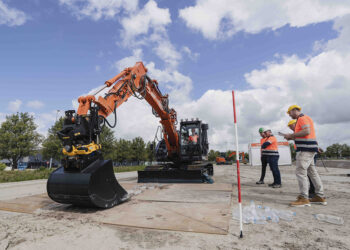
It’s not rocket science. The essence of good excavator operation is simply to move as much material as possible in less time and at a lower cost. The trick is how to achieve this not just 30% of the time, or 60% or 95%, but 100% of the time. Artificial intelligence can help do this.
At the heart of it all is the consistent efficiency of the operator, explains Ken Gray, a co-founder of Dig Robotics and now chief performance officer. Even the most advanced and skilled machine operator can be as much as 40% inefficient at times, meaning higher fuel costs at least. The goal is to make the operator the most efficient he or she can be at all times, every shovelful of material. Importantly, though, AI, robotics, telematics and all the modern technology should not take away control of the operator. In fact, it is the opposite. It can give operators more control and so efficiencies will follow.
Even a modern mid-range excavator, typically 35tonnes, has a 20-tonne digging force and these machines are expensive. Therefore, says Noam Rotem, co-founder of Dig Robotics and now its chief executive, there is a great responsibility for the operator to make the best use of the machinery and his or her time to affect a company’s bottom line. To attain this optimal excavation, AI will set the optimal bucket angles throughout the full stroke of an excavator’s boom, from entry into the material to exit of the material. This will eliminate unessential bucket force and precisely fill the bucket when exiting the material, rather than pushing around material that will not be loaded into the bucket.
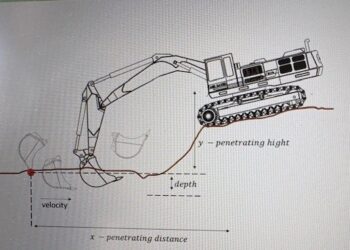
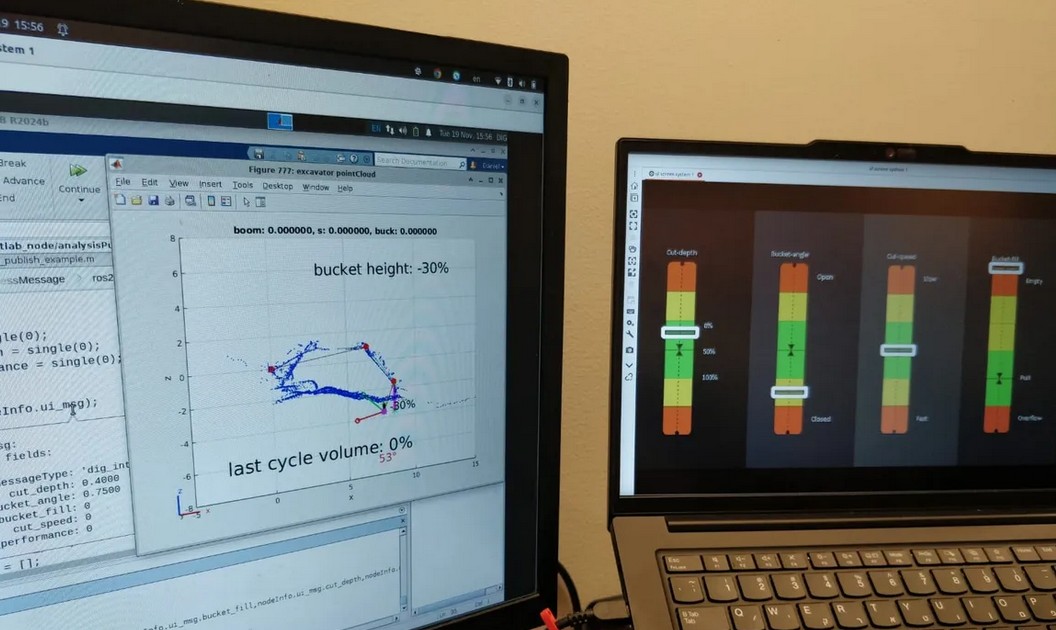
Oded Medina, chief scientist and also a co-founder of Dig Robotics, says the process is about geometrics of movement and kinematics of force. AI algorithms recognise optimum moments that denote when the bucket is full. Successive boom strokes are analysed and the next boom movement cycle is adjusted accordingly – shorter or longer strokes as needed, depth regulated, bucket angles readjusted. The result is less force, meaning less fuel consumption and shorter work times, meaning more time to move onto the next project. All this is done in real time for the operator to see in the cab.
There is also something called the ‘hidden killer’ when it comes to machine operation, explains Rotem. Hidden because it is hard to put a finger on why a machine or its attachment is wearing down sooner than the operator or the company expected. It’s a killer because it basically because it reduces a machine’s usefulness, costs a large amount to replace it or attachments – not to mention slashes company profitability. This happens much more quickly if the machine is moving or pushing around large amounts of material unnecessarily.
An added benefit of incorporating AI into machine operation is the real time effect, says Jeff Gray, Training Expert at Ingenium Plus. An operator can see what is happening almost immediately as it happens. This is what Gray calls “real-time coaching”. An operator wants to consume learning at the point of need, right then and there so they can use what they have just learned. They need that information right now and can apply that learning. Gray says this is “sticky learning”; they will remember it because it is experiential, learning in an absorbable fashion.
Gray also says that modern operators – as with the general public – increasingly want to know where to go to get immediate answers rather than seeking knowledge for the sake of retaining it. He also warns that the next four to five years will see more and more people bringing their own personal devices to the workplace if their employer doesn’t supply such technologies or give them access to these devices and AI technologies.
The presenters:
Noam Rotem
A seasoned technology entrepreneur specializing in robotics, autonomous systems, and industrial innovation. Noam previously worked in the Aerospace and Automotive industries and founded Syracuse, an autonomous tower-crane startup that was successfully acquired in 2022, demonstrating his ability to take complex robotic systems from development to commercial exit.
Ken Gray
Gray has more than 40 years in the global excavation industry. He has held executive roles at Caterpillar, including director of the company’s building construction products division and the excavation division and was the first global director of innovation. Gray is recognised for his understanding of excavator design, excavation operations, operator workflows and OEM product strategy.
Oded Medina
A recognised expert in robotic motion planning and AI, Oded holds an MSc in electrical engineering and a PhD in robotic motion planning. He previously co-founded W Endoluminal, a robotic medical device company and served as chief scientist at Syracuse, where he developed advanced robotic control systems.
Jeff Gray
As chief training officer at Ingenium Plus – a consulting firm headquartered in Cincinnati in the US state of Ohio – Gray explores where AI, brand, technology and service culture converge. He helps clients reimagine their businesses or guides teams toward smarter solutions. Gray served as chief technologist inside IBM Global Services, collaborating with major companies such as SAP, Cisco, Oracle, Adobe and the US Department of Defense to shape strategic investments and design innovations. Over the past two decades, he’s advised Fortune 500 companies and other global brands on digital strategy, AI, machine learning and organisational transformation.
This article was written by David Arminas, deputy editor of Global Highways magazine, and based upon his attendance at a recent Dig Robotics webinar. For more information about Dig Robotics, click here.