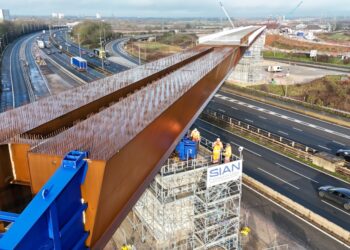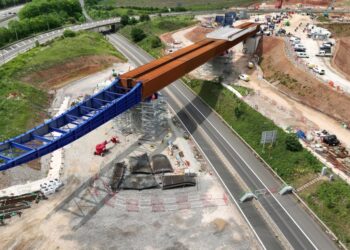
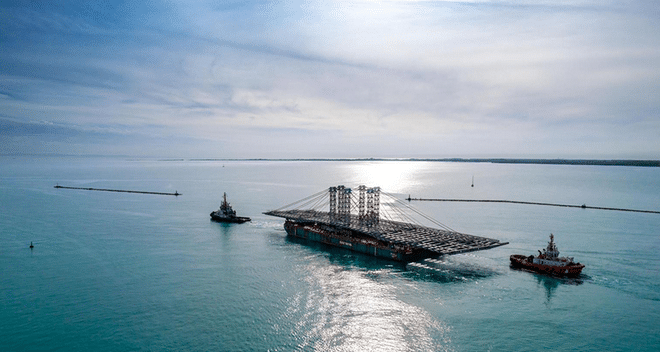
A 150m-long steel deck for the Anne de Bretagne Bridge has arrived by barge in Nantes after being barged from Italy.
The steel addition, weighing 3,100 tonnes, was manufactured in Italy by Cimolai at the company’s Monfalcone plant. It recently arrived in Nantes, northwestern France, by barge after four and a half weeks of travel through the Atlantic Ocean and the Bay of Biscay.
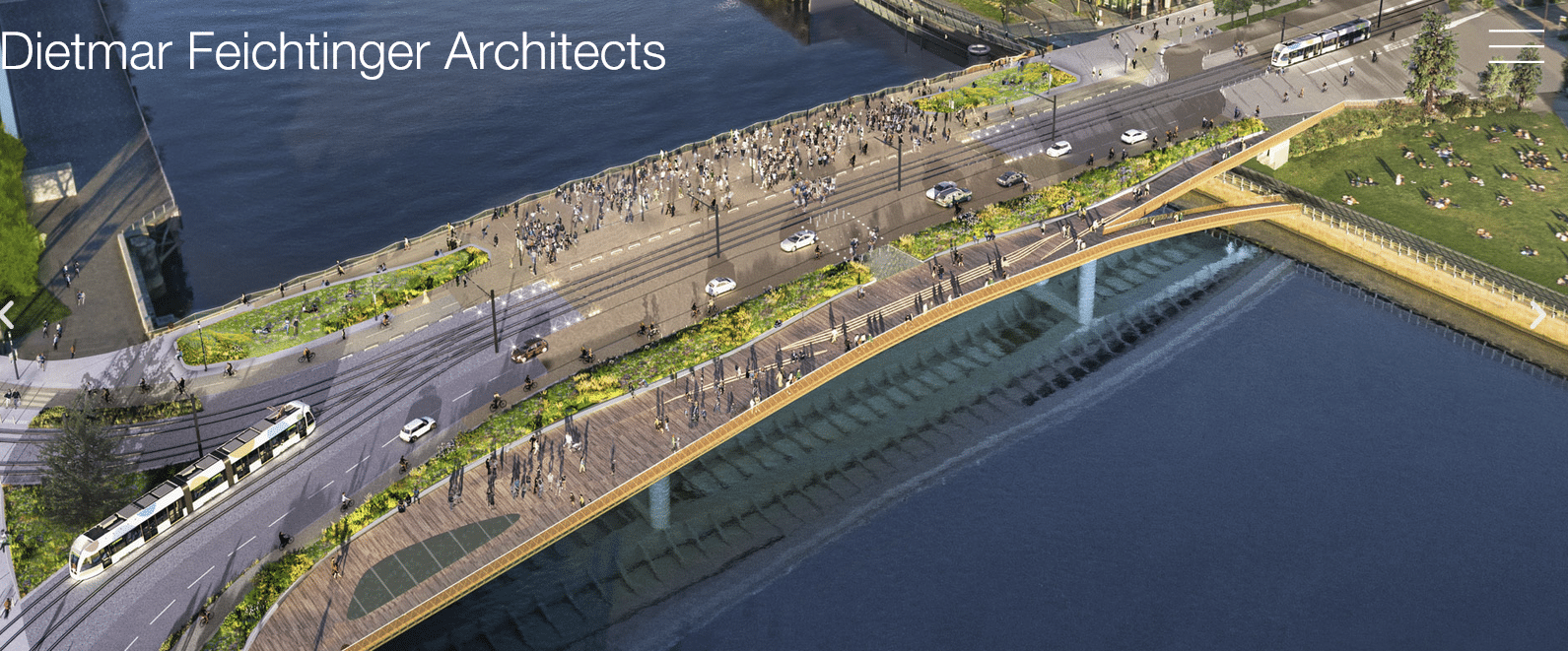
By the end of April, the deck will have been hoisted into place as part of a major renovation – and reimagination – of the existing bridge that was opened in 1975, according to GTM Ouest, the Vinci Construction subsidiary in charge of the Anne-de-Bretagne Bridge project. GTM Ouest noted that when the project is finished, the total surface of the new structure will be around 7,760m² of which 43% will be for pedestrians and 13% for bicycle use.
The existing prestressed concrete Anne de Bretagne Bridge spans the bras de la Madeleine, a branch of the Loire river in Nantes, was opened in 1975 and connects the Nantes city centre to the Île de Nantes. It carries vehicles, pedestrians and trams. Major expansion work began in March 2024 to widen from 18m to 53m, which will make it one of the widest bridges in Europe. The new structure will have nearly a park of nearly 1,800m² of green space, walkways and viewpoints.
The project also emphasises environmental sustainability by reusing the existing concrete piers, saving around 4,800 tonnes of concrete and reducing the carbon footprint by 6,000 tonnes of CO2 equivalent.
Lifting operations to place the bridge on its supports are expected to begin sometime in the spring. Completion of the project and opening of the bridge is likely in late 2027. Cost of the project is reportedly around €60 million.
Transformation of the Anne de Bretagne Bridge is being carried out as a design-build project by GTM Ouest, in partnership with several local stakeholders: Dietmar Feichtinger Architects with the engineering firms SCE (part of the KERAN group), Paume (urban planner), Ateliers UP+ (landscape design), Atelier Roland Jeol (lighting design), the companies Dodin Campenon Bernard (VINCI Construction), Cimolai and the artist Aurélien Bory of Compagnie 111.
According to GTM Ouest, the project is part of a profound transformation of the Nantes metropolitan area, aiming to better connect east and west riverbanks and the river itself. This future bridge will address the challenges of active mobility, public transportation, traffic flow, public spaces and nature in the city. The project addresses environmental challenges by creating dedicated areas for wildlife: linear gardens and planted buffers.
Eco-design is central to this project, thanks to the preservation of the existing structure and the sharing of work with the Nantes University Hospital construction site. The consortium’s project also addresses societal challenges, promoting inclusion, community spirit, and solidarity through the creation of public spaces and improved traffic flow and access. It will integrate seamlessly into the city’s architectural and environmental landscape through the materials used, the ambiance created by the pedestrian walkways, the landscaped surroundings, the viewpoint, the traffic calming measures, and the large public square.
The historic piers of the former transporter bridge are being preserved and highlighted to evoke the city’s past. To accommodate these installations, the bridge will need to be widened. To this end, a bridge-plaza around 35m wide will be built as an extension of the existing bridge. The connection between the old and new structures will be possible by lowering the deck of the existing bridge. This will make it less steep and thus able to accommodate the tramway.
The bridge is named after Anne of Brittany, who died in 1514 and was Duchess of Brittany from 1488 until her death. She was also Queen of France from 1491 to 1498 and from 1499 to her death. She was the only woman to have been queen consort of France twice. During the Italian Wars, Anne also became Queen of Naples, from 1501 to 1504, and Duchess of Milan, in 1499–1500 and from 1500 to 1512.