Exciting changes in construction will reward the aware contractor – *Jeff Winke comments
Hop in a car and drive anywhere in the US and chances are the drive will be on roads and highways that need patching, resurfacing, or widening, and bridges often show signs of needed maintenance. Sadly, things are in bad shape.
On the last two report cards from the American Society of Civil Engineers, the US infrastructure scored a D+. This year’s report urges the government and private sector to increase spending by two trillion dollars within the next 10 years, in order to improve not only the physical infrastructure, but the American economy as well. The roadway infrastructure is badly deteriorated.
According to Statistics Canada, in partnership with Infrastructure Canada, Canadian roads are in better shape due to the fact that nearly 25% of roads have been constructed since 2000. Newer roads means roads in better condition.
As Robert Puente, writing for the Brookings Institute, observed, “Infrastructure enables trade, powers businesses, connects workers to their jobs, creates opportunities for struggling communities and protects the nation from an increasingly unpredictable natural environment… infrastructure is the backbone of a healthy economy.”
In many respects, the future of construction is bright. Construction workers, contractors, and people who know how to design, maintain, rehab, and construct the roadways that people rely on everyday are in high demand. The care and maintenance of America’s road network have been ignored too long and with the increased population, the needs have changed.
The construction industry will be crucial to fulfilling the requirements and goals of North America’s future. Construction has been changing and evolving rapidly during the past 20 years and its dynamic advances will continue. The successful contractor in the future will operate quite differently than today.
The key to all of this is technology.
“Construction contractors have experienced tremendous benefits in newer, more technologically advanced machines and equipment,” said Kris Maas, director of construction product development for Topcon Positioning Group. “And the highly successful contractor has adopted precision measurement systems, GNSS machine control, and geospatial management and collaboration software to ensure seamless coordination among all involved in their projects – which have revolutionised grading, excavation and paving.”
There appear to be five technology trends shaping the future of construction:
1. Data
— Acquiring, using, and sharing data in real time gives contractors advantages of enabling their machines to “talk.” Through connected machines, contractors can remotely monitor progress, communicate with the operator, diagnose and repair problems, track machine location, and provide support. Data collected can confirm quality results and help with bidding on future similar projects. There will be the time when a job site or highway can tell how it should be built through instant data, seamless communication, exact material amounts. “Our MAGNET software solutions suite currently provides real-time connected support for hardware as well as integration with our Sitelink3D service for instant data transfer and connectivity into active project sites,” Maas said. “Additionally, Sitelink3D allows customers to plan, schedule, assign tasks and get reports, all in real time.”
2. Constructioneering
— Constructioneering is a term Bentley Systems and Topcon use to refer to automating the digital construction process through surveying, engineering design, constructible model development, and as-built data collection within a connected data environment to improve construction execution and reduce project costs. It is the creation of collaborative systems to bring all the data into digital models that can be seamlessly shared with machines, operators, supervisors, civil engineers and project owners. Unmanned aerial vehicles or drones are an example of the type of data that will be collected. Drones can provide virtual reality perspective and data about job sites too difficult or dangerous to reach.
3. Smart roads
— Roadways will do more than carry traffic in the future. As solar collector ribbons they may very well be contributing to fuelling the vehicles of the future. Or embedded wireless technology could maintain an electric car’s charge. Metal street name signs will become nostalgic artifacts of times past, since the self-driving pods will be told by the road what street it is on. Roads will heal themselves as cracks form since the concrete or asphalt mix will be embedded with tiny capsules of sodium silicate. When a crack forms, the capsules rupture and release a gel-like healing agent that will harden to fill the void.
4. Overcoming the skills gap
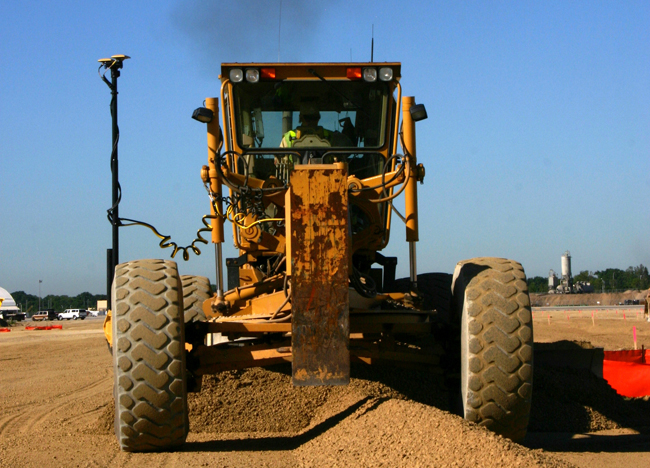
— Technology can help with the labour shortfall and fill the skills gap of new employees. Take a smart, inexperienced worker and place them in the cab of a dozer or motor grader governed by GPS machine control with a 3D site plan displayed and with proper training they will become productive. Technology has not only proved to save time and improve accuracy, but its impact on productivity has been significant. As technology permeates the construction industry there is a need for university and technology school graduate technicians. The need and challenge is there.
5. IoT
— The Internet of Things (IoT) refers to the communication connectedness of machines and objects through sensors via online. Think of IoT as the data aggregation and collection going into a central repository where intelligent decisions can be made based on what has been collected in real time. Workers can be tracked in the field and ensure that they are protected from or at least aware of job site hazards and other potential injuries. Equipment sensors can monitor whether machinery is being productive or in need of repair or preventive maintenance.
“The future is getting closer to us…it’s inevitable,” said Maas. “We continue to develop new technologies and refine the innovations we’ve brought to the market – all with the objective of helping construction contractors to be more efficient, accurate and productive in what is referred to as The Intersection of Infrastructure and Technology. The future expects that of us.”
As the World Economic Forum said: “Over the past decade, digital progress has transformed whole industries, ushering in a new technological era now known as the Fourth Industrial Revolution…These new technologies are not only satisfying consumer demand for better entertainment, shopping and transport. Innovation has improved companies’ productivity and sustainability, and redefined the skills and competencies needed to thrive.”
Clearly, the aware construction contractor will exploit the opportunities provided by technology to ensure greater productivity, better quality, and longer-lasting results.