Changsha, the capital of Hunan province, is capitalising on its well-established equipment and componentry manufacturing base as China’s global Belt and Road Initiative gathers momentum
China is already a big global construction equipment manufacturer with sales of around US$87 billion last year. Annual exports, too, are on a steep rise, reaching $21.5 billion by last November. Changsha is part of this success story with many original equipment manufacturers here as well as hundreds of first and second tier suppliers. Add to this the city’s increasing economic importance as the Beijing government’s ambitious infrastructure Belt and Road Initiative gathers speed across Asia, Africa and parts of the former Soviet Union (see box). Changsha is situated around the start of the old Silk Road networks that flowed westward through Asia and onwards to the Middle East, north Africa and Europe.
Belt and Road, as announced under the leadership of Chinese president Xi Jinping in 2013, is an international blueprint to create a global transport network connecting China to international markets and vice versa. Significantly, Belt and Road also has created funding opportunities for infrastructure projects – now reaching hundreds of billions of dollars – to be loaned to countries along the route. The money, much of it coming from Chinese lending institutions, is being spent for the construction of not just roads but railroads, ports and power generation projects.
For these reasons, the importance of Belt and Road to the Chinese equipment and component manufacturers cannot be underestimated, said Zhang Yujing, president of the CCCME – China Chamber of Commerce for Import and Export of Machinery and Electronic Products. Between 70-80% of China’s machinery exports are now going to Belt and Road countries, he told the conference section of the first Changsha International Construction Equipment Exhibition..
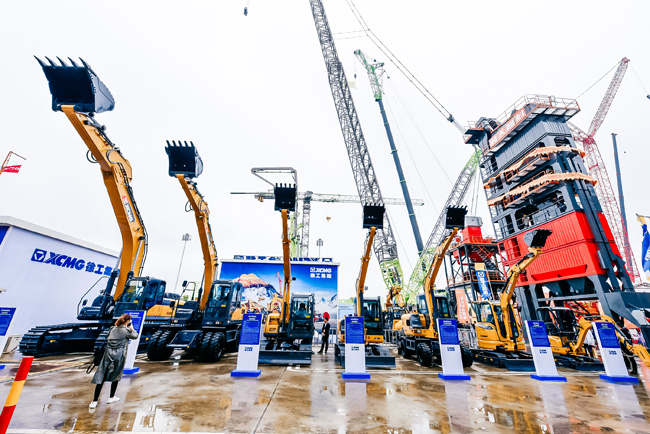
Equipment manufacturer XCMG is a case in point. Around 97% of the Belt and Road areas use their products, the company has reported. In 2018, the number of exported products to Central Asia shot up by 74% over 2017 – beyond the “average for the market”, noted the company. Sales included everything from bridge erecting equipment to heavy-duty loaders. Cranes, in particular, are becoming a big-selling item.
While countries participating in the Belt and Road Initiative welcome the Chinese financial sector investment, they also welcome the Chinese contractors, many of which have great international experience. These contractors also have been buying a lot of their construction equipment in China and taking it with them to projects far afield.
The increased foreign work for contractors and the boost in domestic purchases of equipment come at a time when the rate of expansion of the Chinese market is slowing down, although not greatly. Fitch Solutions, a financial risk management company, has reported that it remains bearish on China’s economic growth outlook. Real GDP growth in China in 2018 slowed to 6.6% and Fitch noted that is lowering its 2019 growth forecast to 6.2%, from 6.4% previously.
Cautiously optimistic
There is also the continuing trade dispute with the US and that country’s raised tariffs on a wide selection of Chinese manufactured goods. It all adds up to a more cautious economic outlook for Chinese manufacturers.
Chinese equipment makers have also been reviewing these domestic purchases by contractors of equipment for external Belt and Road projects. Should the equipment be bought from local suppliers? Also, much of the equipment is sold off when the work is done and the contractor returns home – what is the effect on that country’s domestic market for used equipment?
“As a whole, China’s Belt and Road investment has been beneficial for the countries taking up the infrastructure offer,” said Neil Woodfin, who has been in the construction sector since 2005. He is now vice president of construction equipment for Africa, Middle East and Asia region, as well as global alliances for Case/CNHI International.
The reality is that “Chinese equipment makers and spare parts manufacturers will likely be the greatest beneficiary of this investment” because it is, and will be, Chinese contractors that get the big infrastructure jobs. They will buy their construction equipment in China and take it with them. This “might be a concern” for some non-Chinese equipment makers in the sector globally that will miss out on sales. Case, he noted, doesn’t manufacture in China except for some excavators.
The project-winning contractors are, and likely will be, those with a direct or indirect link in some way to a Chinese government department or agency. Or at least those private contractors with very strong connections with the government, he says. But Woodfin is also quick to point out that this is not corruption, something upon which the Beijing government has done “a good job on clamping down”.
One issue that Woodfin believes many manufacturers in the industry have overlooked is after-sales support for the Chinese-made equipment that leaves China for foreign projects. The contractor may have enough spare parts and technical expertise to keep the machines operating at their most efficient level. But when sold on the local market after the project is finished there may not be that same level of aftersales support. There may be even none at all if the machines have no sales or dealership network in the country or region. The issue is particularly important for Chinese companies – not just construction equipment makers – that have no global reach.
If that is the case, then brand image and quality could suffer. The machines may not be maintained well, break down and word gets around that the equipment is not reliable. This could make any move by the manufacturer to establish a sales or even rental network hard work, he explains.
“It is important that local distributors are found which can be trained to maintain such equipment,” said. They can be paid a commission by the equipment maker to take in hand the aftersales work.
In fact, this lesson was learned by the World Bank several decades ago. Woodfin recalls a time when Massey Ferguson tractors were being sold overseas for work on farming projects. When the work ended, the little-used tractors stayed in the local markets and soon fell into disuse for lack of spare parts and technical knowhow. A lot of money was then spent by the project organisers to train local people and ensure a parts supply chain. But the cost of it paid off handsomely, not simply because it employed people but because it boosted the local market for similar machines now that the people could maintain them.
Persuasion
Allen Hsia, director of overseas marketing for Chinese manufacturer Zoomlion, is well aware of the importance of maintaining good relationships with dealers in the Belt and Road countries – relationships that have taken years to build up. With around 70% of Zoomlion’s exports going to Belt and Road countries, there is a lot of brand image at stake, he explained.
It sometimes needs a little persuasion, he said, to get Chinese contractors with work in Belt and Road countries to see the wisdom for all concerned – themselves, the manufacturers and dealers – of buying or renting locally. Local dealers can supply parts and servicing immediately. They also can advise on what equipment has been working best in what ground conditions, be they marshy and soft to hard and hilly.
On the surface, a Chinese contractor might want to buy equipment more cheaply in China rather through a local dealer. But that is short-term thinking for a medium- to long-term project, said Hsia. There will be the added cost of either the manufacturer or contractor shipping out the equipment. Then there is more cost for the contractor to find local servicing which may not be up to the same quality as a recognised OEM dealer.
A local authorised dealer would be in his rights to ask why his Chinese OEM is not supplying the equipment through his or her agency, especially if the deal is exclusive. The obvious solution to all this is to push the business through a local dealer network, Hsia pointed out. The dealers will be there long after the contractor has packed up and returned to China.
Avery King, managing director of Sunward’s European business, started out in the technical services area of the company and knows how essential it is to provide parts and service to clients, be they European, Asian or African.
He helped establish the company’s European distribution centre in Belgium several years ago, explicitly to sell to dealers and provide a better service to their clients. A lot of machines are sold to rental companies and good relationships are paramount, he says.
Avery King, managing director of Sunward’s European business, started out in the technical services area of the company and knows how essential it is to provide parts and service to clients, be they European, Asian or African.
He helped establish the company’s European distribution centre in Belgium several years ago, explicitly to sell to dealers and provide a better service to their clients. A lot of machines are sold to rental companies and good relationships are paramount, he says.
The issue of contractors buying domestically in China and transporting the equipment overseas to Belt and Road countries has been mostly in Africa, he believed. Sometimes a dealer network doesn’t even exist. But this simply means there is an opportunity for the manufacturer to set one up.
It also means that the OEM has an opportunity to be creative locally with their dealers in offering specific services to the Chinese customers. There could be deals done to train local non-dealers in the manufacturer’s products, for example. Also, dealers can offer local advice that the manufacturer would never be able to do.It should be remembered that China’s Belt and Road policy is only six years old, noted Ban Yubing, director of international cooperation within the China Construction Machinery Association. “Contractors are smart,” he said. “They are getting to understand the financial aspect of buying equipment domestically versus buying locally. After all, this is basically another aspect of globalisation in the construction sector.”
It appears that many more projects are in the pipeline for Chinese contractors, so there will be more and more decisions made that a likely to favour buying locally overseas if the numbers add up, said Yubing.
Belt and Road
China’s Belt and Road Initiative has put the eastern cat among the western pigeons. The understanding that large infrastructure project initiation will remain the preserve of western governments and backed by mainly western financial institutions is now a thing of the past. Chinese financing, albeit comparatively small, is here to stay and expanding.
Gone are the days of infrastructure loans, grants and aid being tied to political, economic or social reform, as often has been the case with western deals. China is much less demanding, if at all, on these goals. Beijing notes that it focusses on benefits to improve the local economy for the benefit of all in the country. Also, the money can now come for these Belt and Road projects from eastern sources, one being the Asia Development Bank, a mainly Chinese financial institution.
Project work is not necessarily going out to tender under a loan from the ADB and Chinese companies will get the work. To what extent they use local contractors has been an issue and China is increasingly hiring local companies, according to many equipment manufacturers