The demands placed on modern road surfaces are constantly increasing. In addition to high load-bearing capacity and durability, environmental aspects and energy efficiency are increasingly coming into focus.
Against this backdrop, Butonal MB 5126 additive – a water-based (aqueous) polymer dispersion that allows the asphalt mix to be modified directly in the mixing plant – was used for the first time in Germany. It was part of a pilot project in Dortmund where the aim was to improve performance of the asphalt while reducing processing temperatures.
Butonal MB 5126 creates a foam structure when mixed into the asphalt mixer. It leads to the formation of a polymer network in the binder, and thus to a polymer-modified asphalt. The[kh1.1][DA1.2] technology allows the polymer content to be flexibly adjusted depending on the traffic load – for example, for heavily used intersections or bus lanes – without the need for different special bitumens.
Pilot project on Bornstreet
Bornstreet, a main road in Dortmund, was selected via a data-based infrastructure management system. The decision was based on condition data (ZTV-ZEB), substance analyses (pavement scanner, georadar) and operational experience. The measure comprised the renewal of the entire bound superstructure due to severe substance loss.
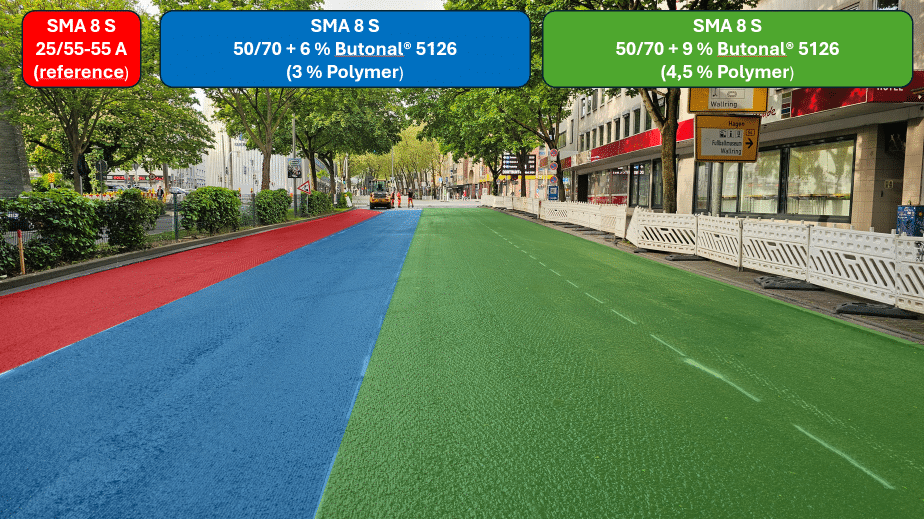
Three variants of stone mastic asphalt (SMA 8 S) with temperature-reduced asphalt (TA) were tendered and installed for the asphalt-surface course:
– Variant 1 (reference): SMA 8 S with PmB 25/55-55 A, at a temperature of ~180°C.
– Variant 2: SMA 8 S with 6% Butonal MB 5126 (3% polymer), at a temperature of ~145°C.
– Variant 3: SMA 8 S with 9% Butonal MB 5126 (4.5% polymer), at a temperature of ~145°C.
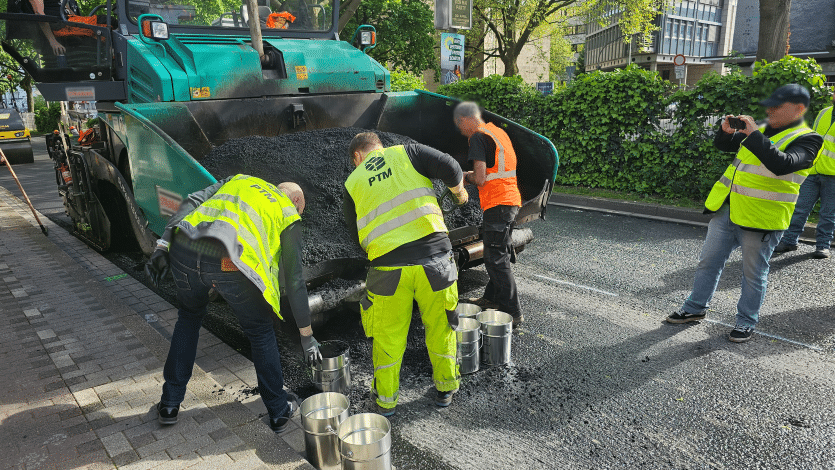
The modification was carried out lane by lane: the high-traffic bus lanes were given variant 3, the other lanes variant 2. A smaller area was equipped with the reference variant.
Paving and compaction
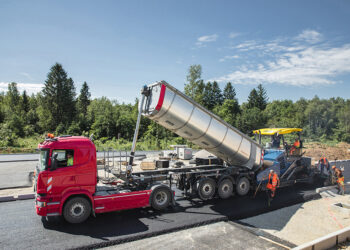
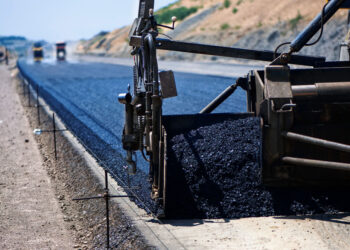
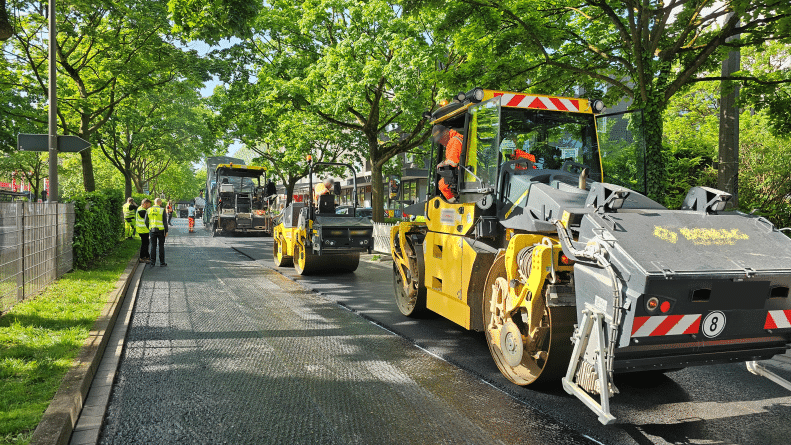
Paving took place on April 30, 2024, at air temperatures of 19°C (variant 3) and 23°C (variant 2). The mix temperatures were between 152°C and
158 °C, the paving temperatures between 146°C and 152°C. Despite the lower temperatures, the material proved to be very compactable.
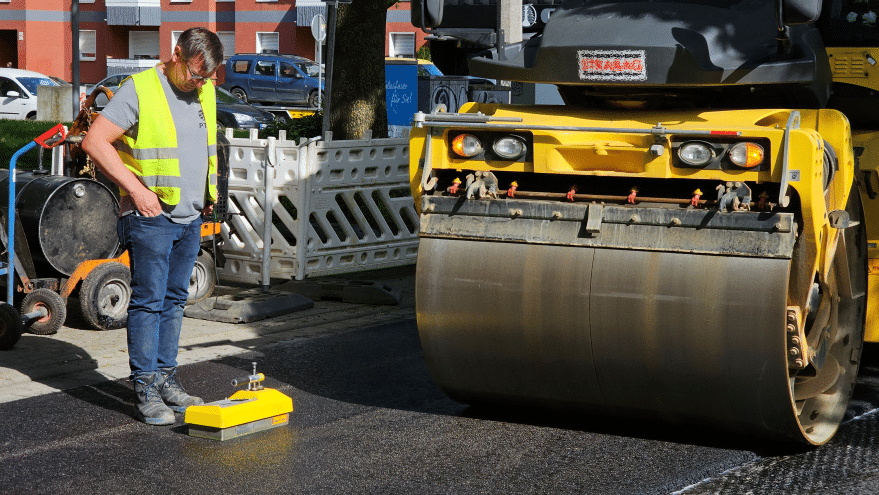
Radiometric measurements showed
– Variant 3: degree of compaction 100.7%, void content 1.6% by volume
– Variant 2: degree of compaction 100.3%, void content 1.9% by volume
– Reference: degree of compaction 99.5%, void content 3.2% by volume
Control tests
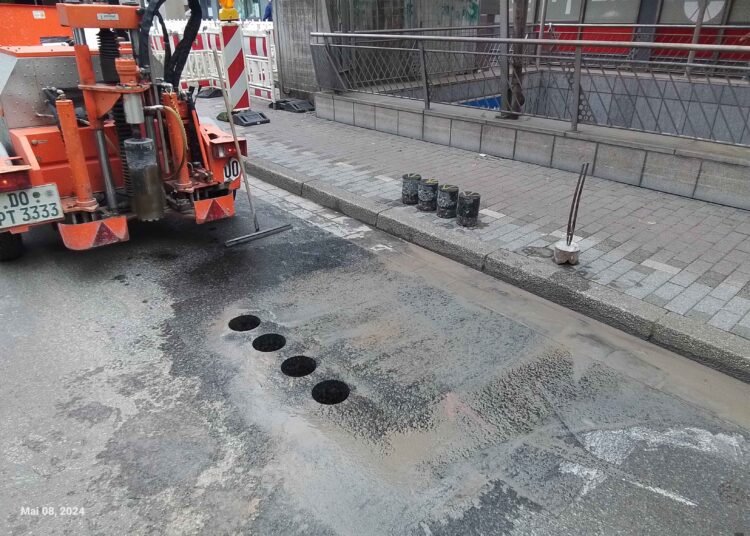
On May 8, 2024, drill cores were taken and tested in accordance with ZTV Asphalt-StB 07/13. The results confirmed the measurements taken during construction:
– Variant 3: degree of compaction 100.4%, void content 2% by volume, layer bond 24.5kN
– Variant 2: degree of compaction 101%, void content 1.6% by volume, layer bond 24.9kN
– Reference: degree of compaction 99.2%, void content 3.9% by volume, composite layer 10.5kN
Performance tests
– Stiffness behaviour
The stiffness was determined using multistage tests at different temperatures and a test frequency of 10Hz. Results showed higher stiffness at medium temperatures (0-20°C) with Butonal MB 5126 and lower stiffness at low temperatures (< 0°C) compared to the reference.
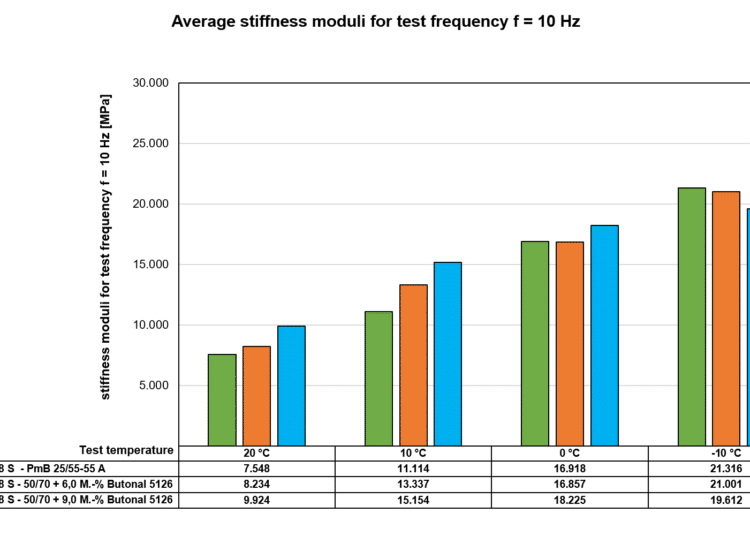
Figure 1: Average stiffness moduli as a function of test temperature at f = 10Hz
– Trace formation
The rutting was tested up to 100,000 rollovers. Variant 3 showed the lowest rut depth (3.9mm), while the reference showed the highest rut depth (4.7mm). A slight improvement in deformation properties was observed with Butonal 5126.
– Deformation behaviour under heat
Uniaxial compression-set tests at 50°C and 60°C showed significant improvement in deformation resistance with Butonal MB 5126. Variant 3 was the only one to meet the requirement of 10,000 load cycles.
[kh2.1]
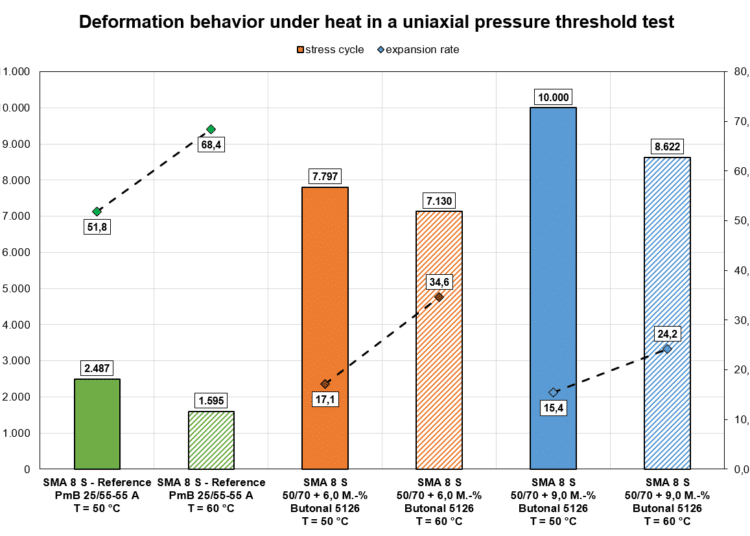
Figure 2: Test results on the deformation behaviour under heat of all tested variants
– Cooling properties (TSRST)
The cooling tests resulted in fractional temperatures < -20°C for all variants. Variant 2: -3.3°C, variant 3: -2.8°C. Breaking stresses were between 4.1MPa and 4.5MPa.
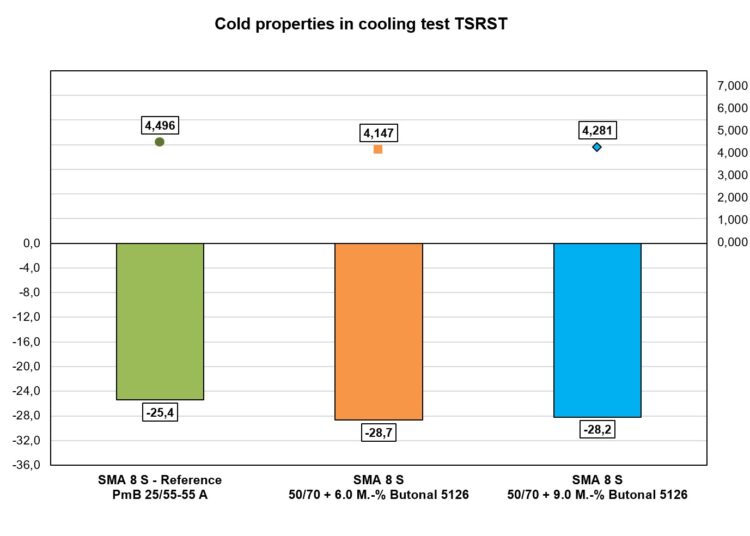
Figure 3: Test results on cold behaviour – cooling tests
– Tensile threshold tests (UCTST)
The elongation at break was significantly higher in the modified variants: reference: 6.7 ‰, variant 2: 12.4 ‰, variant 3: 13.9 ‰. The failure load cycles were comparable, and the fatigue resistance of all variants was considered sufficient.
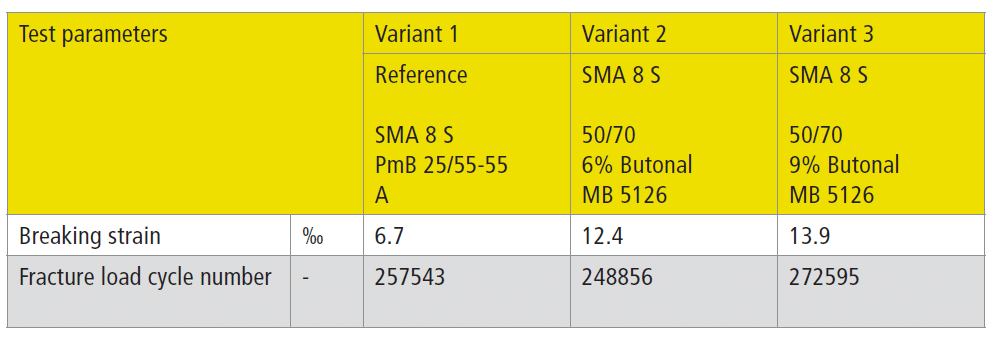
Table 1: Arithmetically averaged test results for uniaxial tensile stress-strain tests according to TP Asphalt-StB, Part 46B
The future
The tests show that temperature-reduced asphalt mixes with Butonal MB 5126 meet the requirements for paving and compaction. But they also perform better than conventional mixes in terms of deformation resistance, low-temperature behaviour, fatigue and stiffness behaviour. The technology offers a sustainable and adaptable solution for municipal road construction and enables a flexible response to different load scenarios.
The results of the pilot project in Dortmund underline the potential of Butonal MB 5126 for a broader application in road construction – both in a municipal and supra-regional context. The possibility of direct modification in the mixing plant, the reduction in processing temperatures and the improved performance make the additive a promising component of future asphalt strategies
Daniel Gogolin has been managing director of the engineering group PTM Dortmund since 2014. PTM specialises in testing and researching various materials, particularly asphalt, bitumen and additives, for public and private clients. He is also head of PTM’s asphalt-testing laboratory. In 2006 he completed his civil engineering studies at Ruhr University Bochum and stayed on as a research assistant in the field of transportation infrastructure until 2011. Gogolin is a board member of the Federal Association of Independent Institutes for Structural Engineering Testing and a lecturer in road-construction technology at Ruhr West University of Applied Sciences.
Mario Šandor joined BASF in 1998 and is now head of business management for asphalt performance for EMEA. He studied chemistry at the Technical University of Munich and obtained his doctorate in analytical chemistry at Lehigh University in the US. Šandor supports various associations through his memberships, including the European Asphalt Association (EAPA), the German Asphalt Association (DAV) and is a board member of Eurobitume.
Thomas Falvo studied economics at the University of Cologne. After serving as managing director of the family road-construction company, he moved to the asphalt-additive manufacturer Star Asphalt in 1999, where he also served as managing director until 2014. During this period, he strengthened the company’s cooperation with Calabria University, publishing several papers, mainly related to bitumen rheology. After 10 more years at Ingevity as business development manager for EMEA, he joined BASF in 2024 as senior technical marketing manager for asphalt performance for EMEA.