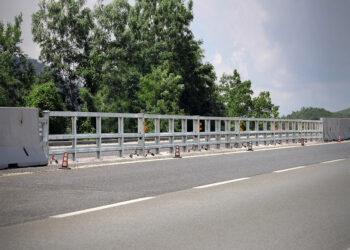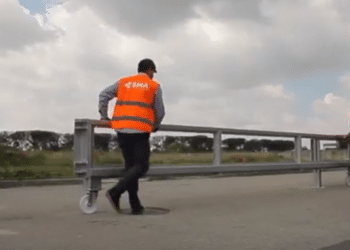
All vehicle restraint devices on European roads are – or should be – certified according to the European impact standard EN 1317, implying conformity. But it doesn’t necessarily ensure that the crash barrier will perform its main aim of saving the vehicle occupants’ lives.
This is especially the case for frontal barriers, such as crash cushions and end terminals. The so-called capacitive test for crash cushions performed by using the heaviest vehicles is a frontal test at 110kph using a 1,500kg vehicle. The impact of this one-and-a-half-tonne vehicle with the obstacle generates around 701kJ of kinetic energy.
But in reality, there is a big difference between the vehicles used for EN 1317 certification tests and those circulating on European roads. There are more and more sports utility vehicles – SUVs – that weigh more than 2,000kg on European roads.
US versus European
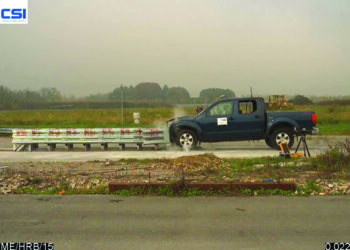
The situation in the US is different than in Europe. According to the American NCHRP 350 and its latest version, called MASH (Manual for Assessing Safety Hardware), the performance of crash cushions and end terminals must be evaluated using a more-than 2,000kg pick-up truck. Also, attention is paid to the load balance during impact which could lead to rollover of the impacting vehicle.
At the moment, European Union member countries and some neighbouring countries including Iceland, Norway, UK, Russia and Israel are using EN 1317. But in many countries, such discrepancy between vehicles required for crash tests and vehicles on the roads has led to the exclusion of cushions and end terminals being tested according to European standards. Among these countries are UAE (United Arab Emirates), Malaysia, Mexico, Peru and even Australia and New Zealand. Other countries in Africa, too, are deciding which standard will be used – American or European.
The problem is also a marketplace issue for system manufactures in based Europe. The Americans pushed to approve the NCHRP – and now MASH – standard because the test vehicle is heavier and more “dangerous” in case of an accident. This is the logic for presuming that NCHRP 350 products are safer than EN 1317 products. The proliferation of SUV and pick-up trucks on highways around the world, including Africa and Asia, has helped the American crash cushions to be preferred over the Europeans. European products are, therefore, less competitive than US ones.
It is acknowledged that NCHRP/MASH products are considered non-compliant in Europe and only CE-marked products can be installed within the EU. However, to date the CEN (European Committee for Standardisation), an association that brings together national standardisation agencies of 34 European countries, is not facing up to the problem of obsolete vehicles being used as test vehicles in Europe.
Speed certification
Another worrying aspect is that impact tests on crash cushions lead to the homologation (certification) of the device for use at four vehicle speeds: 50kph, 80kph, 100kph and an upper limit of 110kph. However, the maximum speed limit on vast majority of European major highways and motorways is often, in fact, 130kph.
It is, therefore, worth questioning whether crash barriers compliant to EN 1317 are actually safe.
It’s also important to highlight that EN 1317, while certifying crash worthiness, does not prescribe norms for the installation of the barrier along a road. Installation regulations are left to national governing bodies. If there were pan-European regulations focussing on installation, these might provide additional guarantees of safety and performance reliability of barriers.
We would suggest that safety for passengers is assured by devices which are compliant with the PRR rule – Performance Robustness and Repetitiveness.
The more robust the device, the more effectively it response to impacts, according to dynamics not now contemplated in impact tests. For example, this would be an impact at 130kph or with an impact angle greater than 20°.
Regarding repetitiveness, crash tests are done under carefully considered conditions that will show optimal performance of the system. However, once installed along a road, there may be many, many more variable conditions under which the barrier must perform and it must do so repeatedly.
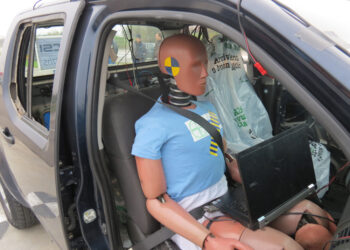
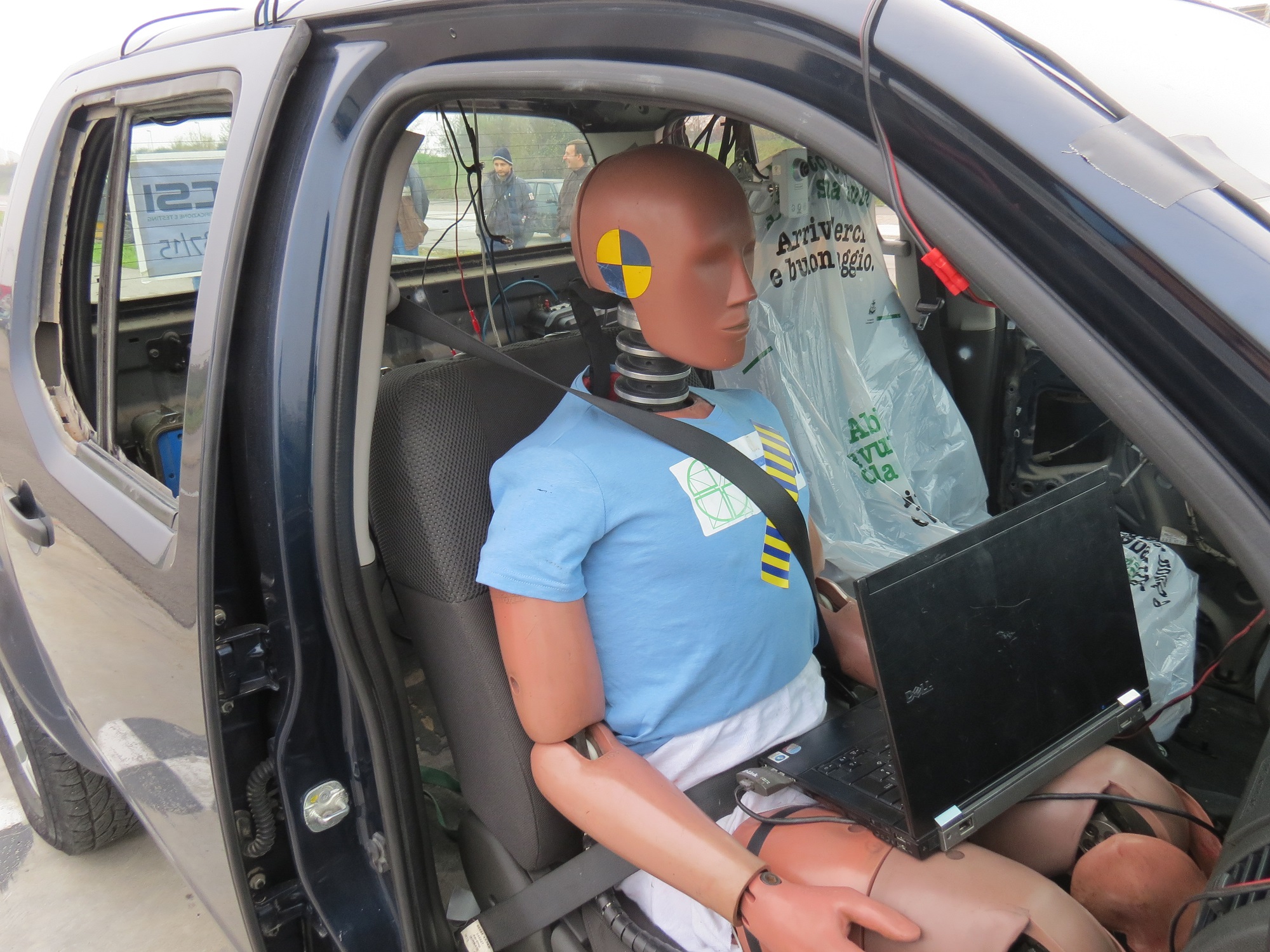
Furthermore, EN 1317 does not require the assessment of injuries to vehicle occupants, despite the fact the such devices aim to save lives. In fact, both European and American standards for evaluating vehicle restraint systems don’t require to crash test the system with an onboard instrumented dummy, despite such sophisticated devices existing.
Useful dummies
For example, there is a dummy being used by EuroNCAP (European New Car Assessment Programme) for rating the passenger safety of vehicles during frontal accidents. It analyses head, spine and chest injuries. Yet this tool is not required for the evaluation of compliance with EN 137, NCHRP 350 or MASH 2016. This assessment void could be filled easily by using a EuroNCAP dummy.
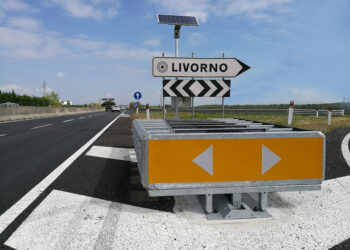
It should furthermore be noted that the American norms of NCHRP and MASH don’t consider the assessment of injuries to vehicle occupants. When is it possible to be sure that a device complies with the PRR rule? When vehicle occupants live to tell the tale. Those declarations are more worthy than any certification of compliance.
A very useful instrument to analyse the behaviour of crash cushions installed on a road is an impact-monitoring system that includes some ability to video the crash. SMA Road Safety already has such a system, called Geronimo. It is supplied together with the crash cushion and is triggered by way of a barrier-mounted sensor.
Importantly, Geronimo records not just the behaviour of the barrier, but the dynamics of the accident, from the instant of impact. Moreover, Geronimo alerts emergency services in real time about a crash – extremely important when not just minutes but seconds can save lives.
Such impact-monitoring systems as Geronimo – a 100% made-in-Italy solution – can ensure the safety of vehicle passengers at a time when the EN 1317 European Standard seems to be obsolete and ineffective.
SMA Road Safety is a global Italian safety barrier manufacturer, based in Marcianise. Apart from making the Geronimo system, SMA manufactures the Leonidas crash cushion, which is compliant with both the European EN 1317 and US NCHRP 350 standards.