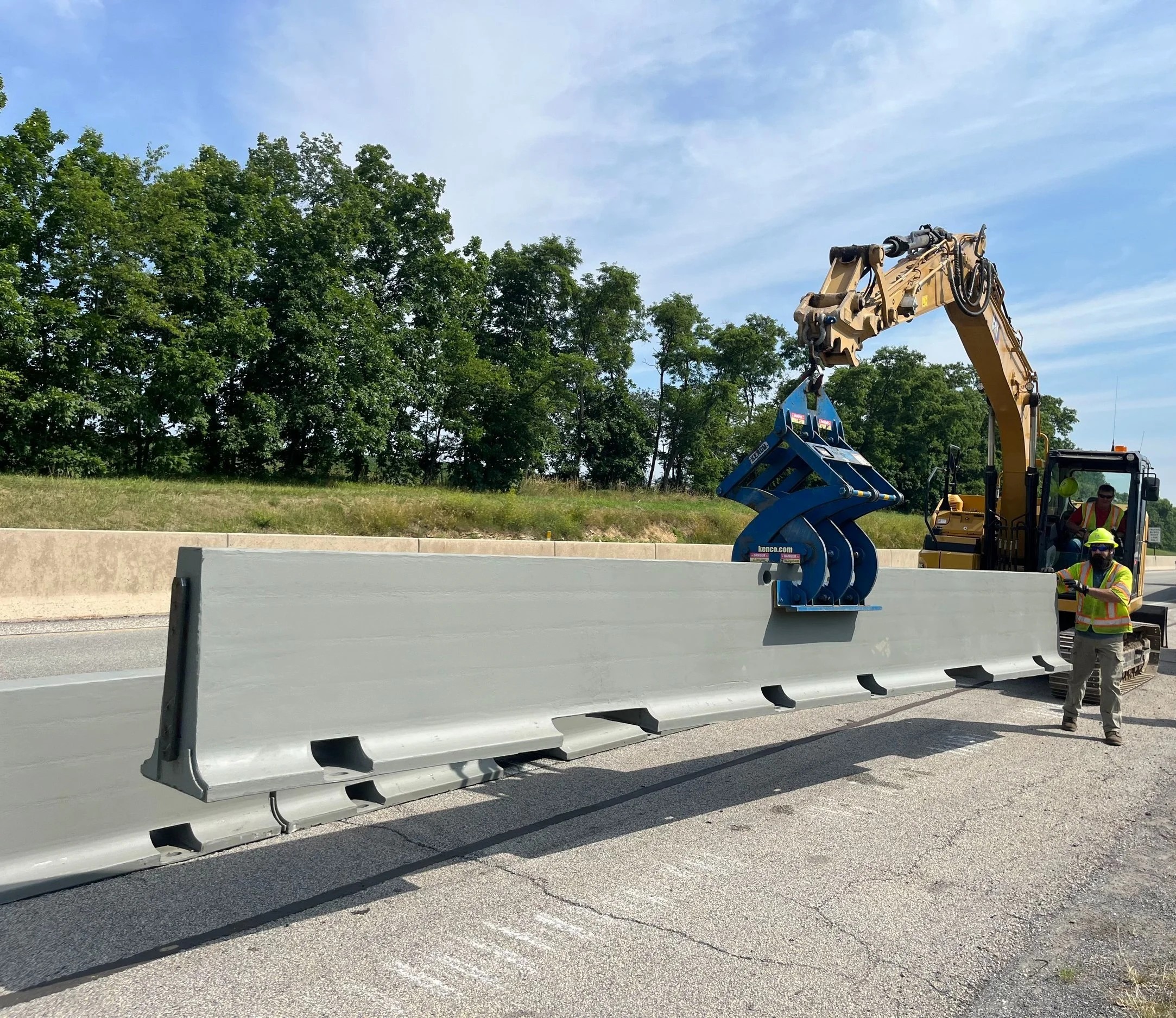
Asynt Solutions completed the company’s first project in the US state of Ohio, installing a roadside-barrier system on a bridge-replacement job near Clarksburg.
According to Asynt, the work in Ohio highlights how contractors are adapting to new federal crash-safety standards. Since 2019, state departments of transport have been moving away from the old NCHRP 350 barrier standard to the newer MASH TL-3 requirements which are designed for heavier vehicles and higher speeds. Much of the concrete-barrier inventory currently in use no longer qualifies, forcing states to replace or retrofit systems under growing time and budget pressure.
The roughly 150m-long barrier system, developed by Ohio-based Asynt Solutions, was delivered on a single truck and installed before lunch using a skid steer. This is rarely possible, said Asynt, with traditional concrete barriers that weigh between 3,630kg and 4,535kg each. Asynt’s APE barriers weigh about 545kg, allowing crews to deploy work zones faster and with less equipment.
“We deployed about 500 feet [150m] of barrier and the entire shipment fit on a single truck that wasn’t even close to full capacity. That kind of logistics efficiency is very difficult to achieve with traditional concrete barriers,” said Archie Scott, a mechanical engineer and founder of Asynt Solutions.
Scott developed the fibre-reinforced polymer system with interlocking joints after working in composites manufacturing and questioning the inefficiencies of transporting heavy concrete barriers many kilometres to highway work zones. Dimensions are 81cm high, a standard 730cm long and a standard radius capability of 76m. The system is also chemically inert to road salt, so it neither rusts nor corrodes. It also has a 25-year lifespan, according to the company.