Spencer Bridge Engineering has rolled out an AeroTruss underdeck bridge-inspection system during phase two of maintenance work on the 200-year-old Menai Suspension Bridge.
Earlier this year, the company, based in Hull, northern England, started phase two on the bridge that links the island of Anglesey to north Wales, spanning the Menai Strait.
To mark the bridge’s 200-year anniversary, Luke Fisher, bridges director at Spencer Bridge Engineering, represented Spencer at recent anniversary celebrations. The event brought together leading engineering institutions and industry partners to recognise the bridge’s legacy and to witness the unveiling of a commemorative plaque marking the significant milestone.
The Spencer team has a long-standing history with the bridge, having first undertaken key works for the client, UK Highways A55, and the bridge owner, the Welsh government, in 2020. They were then appointed to replace 73 concrete footway panels on the approach spans of the bridge.
Since then, Spencer Bridge Engineering has carried out two further projects on the bridge: the installation of emergency failsafes in January 2023. The first phase of the most recent maintenance and repair works was completed in November 2024, during which 168 of the bridge’s 208 hangers were successfully replaced.
The second phase of essential maintenance consists of six key packages. The first package of works involves the repair and maintenance of concrete corbels beneath the bridge’s approach spans, where corrosion of the internal steel reinforcement has been identified.
The majority of corbel repairs were completed in 2025 using non-intrusive methods to minimise risk. During phase two, 15 corbels require repair, involving the careful removal of concrete to enable the repair or replacement of existing steel reinforcement. Once these works are complete, the team will move on to the parapet refurbishment. This involves installing access systems to allow sections of the parapet to be removed for off-site repair and repainting, before reinstatement.
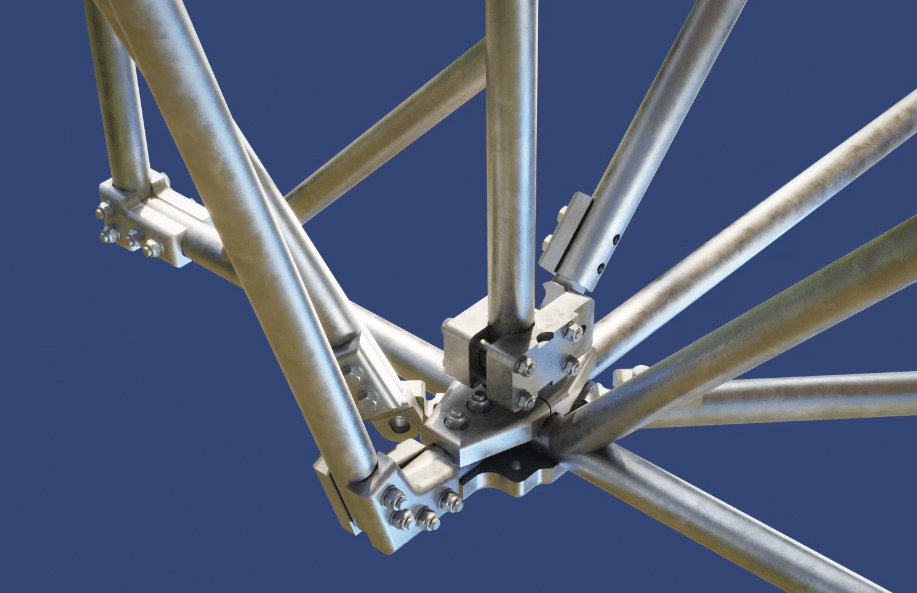
The project will then move on to the most significant package, underdeck painting, during which Spencer will use its bespoke modular moving-access system, called AeroTruss, for the first time. The system has been designed and developed by its in-house team to enable safe and efficient underdeck access for all painting and structural repair tasks.
Use of the AeroTruss system, specially made for Spencer over a three-year development period, also marks the re-start of phase-two work. According to Wales Online news website, Spencer had hoped to use its AeroTruss system for the phase-two works that were to start in March last year. However, phase two was delayed until last summer because of procurement and licensing issues.
After only weeks of work phase two was halted when faulty nuts and bolts were found on the bridge’s underdeck in October. Meanwhile, the completed section of the AeroTruss system lay covered in storage at Port Penrhyn, near the city of Bangor on the north Wales coast.
Thankfully, issues have been resolved and the sections were readied and recently barged along the north Wales coast, into the Menai Strait and hoisted into place under the bridge deck. Two bearing platforms have been installed at the towers of the bridge, alongside two painting platforms that will move along the deck.
Spencer says that the introduction of AeroTruss on the Menai Suspension Bridge demonstrates how bespoke access innovation can significantly enhance the delivery of complex maintenance works. It is a standard solution for rapid deployment on bridges and structures for temporary and permanent works. AeroTruss can reduce installation time, minimise structural loading and provide continuous, controlled access beneath the deck. The system enables works to be carried out more efficiently while maintaining the highest safety standards.
Luke Fisher, bridges director at Spencer Bridge Engineering, explains that using the AeroTruss on a landmark structure of this significance underlines the capability of the system as a modern alternative to traditional access methods on complex bridge projects. The maximum span is 50m. The person payload is 400kg/m² and the grit payload is 25kg/m². “The system provides a number of innovative features that are of particular benefit to this project,” he said.
“Once installed, the platforms have an integrated encapsulation system that allows the work area to be rapidly sealed to provide [workers with] an environment suitable for blasting and painting operations, retaining dust and debris within the platform. This is particularly important when working over the Menai Strait.”
The encapsulation system is called Speedy Curtain and allows for work to continue up to a wind speed of 20m/second, around 72.5kph.
Tom Inglis, project manager at Spencer Bridge Engineering, notes that phase two is complex and has needed detailed planning to sequence the operations to mitigate disruption for bridge users. “During the planning phase, we managed to develop our methodologies, including AeroTruss, to eliminate the need for traffic management for most of the programme. Once working on the underdeck, bridge users will be unaware of our presence, despite us undertaking significant construction operations below their feet,” he says.